

Found sooner.
A sweep finds you when it passes close enough to resolve you. At 500 metres you are about three and a half arcminutes across. Pegged flat, the banner is nearly thirteen. That extra width is picked up from further out, so each leg of a search covers more ground. Fewer legs, less time on the hill.
1850 × 600 mmNo signalNo batteryNo subscription

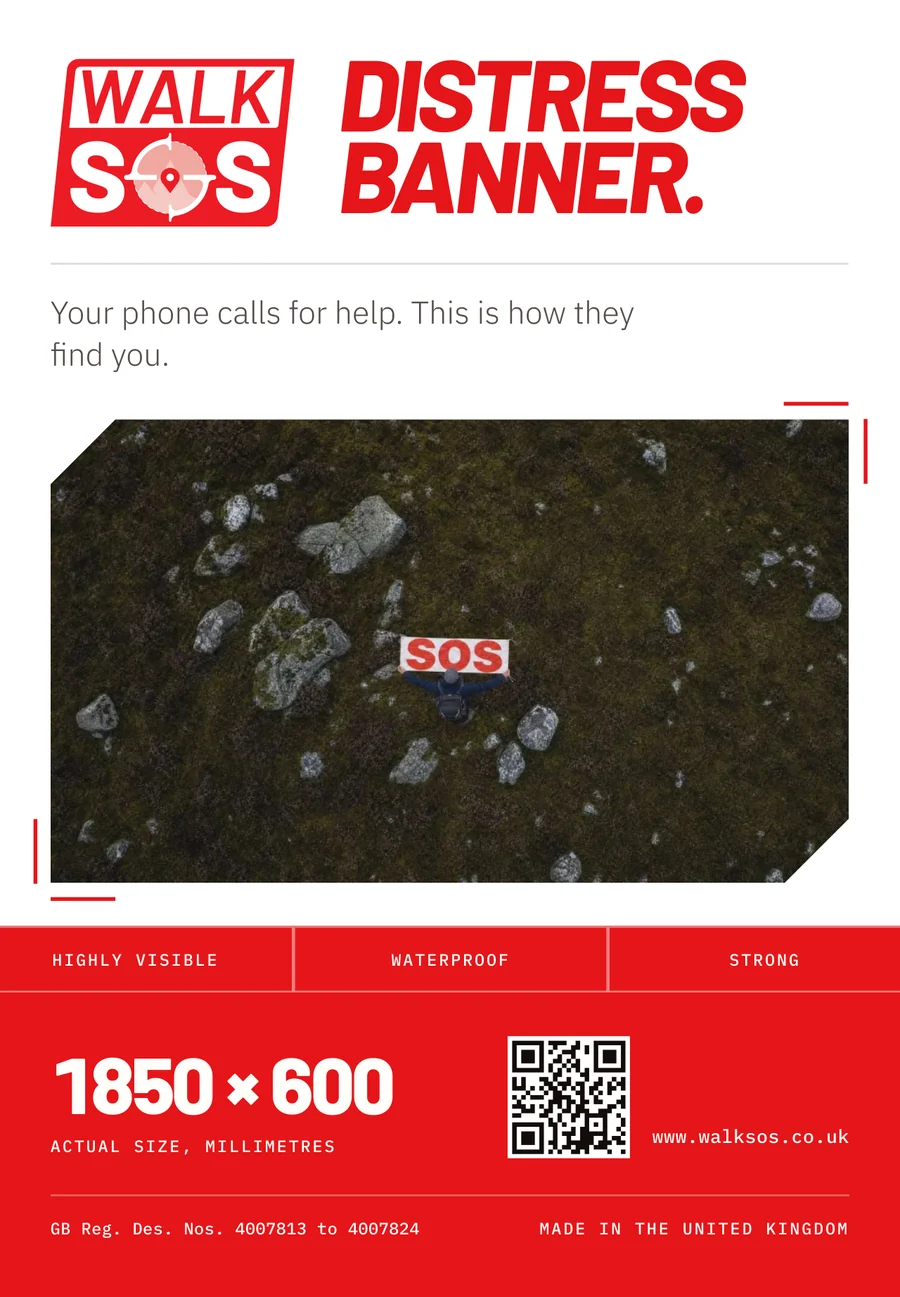
A search team is not looking for you. It is looking for contrast.
Mountain Rescue sweep ground on foot and from the air. What stops a sweep is not that a person is too small to resolve. At 500 metres a walker is about three and a half arcminutes across, and the eye resolves one. What stops a sweep is that three arcminutes of olive and grey sit inside a hillside of olive and grey.
Drag the distance. The walker never moves.
Representative ground 2 m contoursSlant range 500 m
Plan view, drawn to true angular size at the stated range. The hillside, its contours and its shading all come from one height model, so the map and the ground agree. It is representative upland, not a surveyed place. Small angle: angular size = (size ÷ distance) × 3438
The walker is a smudge among other smudges. The banner is a white rectangle.
Resolution is not the variable you can change. Contrast is. A wet British hillside is dark, and flat cloud keeps it dark. So the banner is white, because white is the furthest thing from that. The SOS is red for meaning rather than contrast: once a crew has seen the white, the letters say what it is.
Big enough to see. Small enough to carry.
It folds in half each way, then down again, until it is a pad you can hold in one hand. Then it goes in the bag with the printed card facing out.
deployed 300× 90 mm
bagged 4corner eyelets
pegged or weighted
- Power
It works when the phone does not
No signal, no battery, no subscription, no pairing, no annual fee. It is a printed sheet. The only failure mode is leaving it behind.
- Siting
It is read from above as well as across
Peg or weight all four corners and angle it so a helicopter crew sees the face of it, not the edge.
- Scope
It does not replace your phone
Your phone starts the rescue. The banner finishes it: the last few hundred metres, where a grid reference stops being precise enough and somebody has to actually see you.
Printed on the back panel
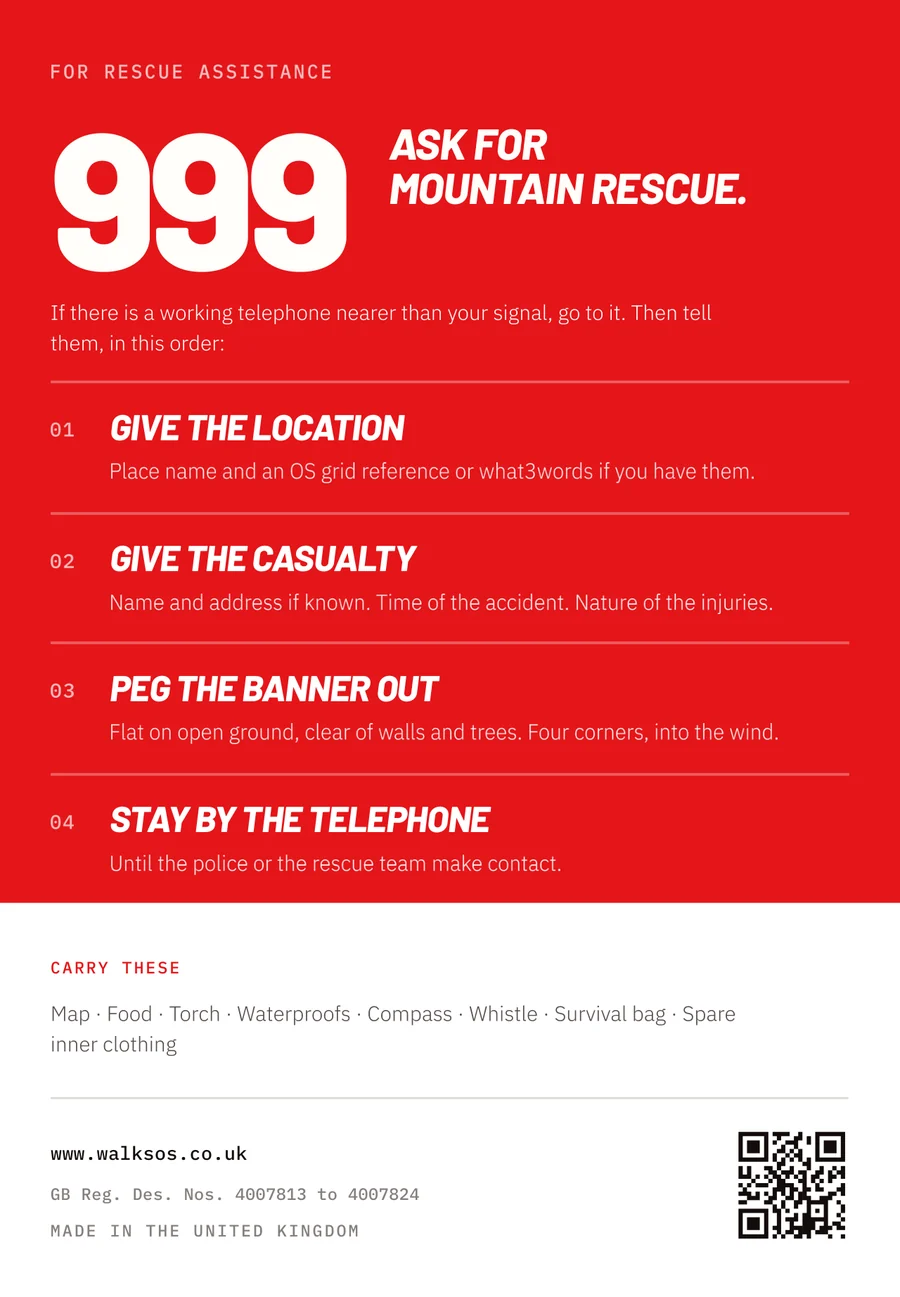
If you need rescue
Printed on the banner itself, at a size you can read in bad light with cold hands. It is here so you can read it before you need it.
- Call
Dial 999 or 112. Ask for Police, then Mountain Rescue. On a cliff or shoreline, ask for Coastguard.
- Give your location
what3words, OS grid reference or latitude and longitude. Any one of them is enough.
- Report it as CHALET
Casualties. Hazards. Access. Location. Emergency services needed. Type of incident.
- Stay exactly where you are
Until the team contacts you. Moving is what makes people hard to find. If the team texts you a link, tap it. It sends them your position.
Deploy
Deploy the banner while you wait. Peg or weight all four corners. Angle it so it can be seen from above as well as across. Stay with it.
Before you go
Text register to 999, then reply YES when it answers. Two minutes, and it lets you reach 999 by text when a call will not connect. You cannot register once you are in trouble.
No phone
Six whistle blasts or six torch flashes, repeated every minute. Keep the banner deployed.
One product. One size.
There is no range and there is no configurator. There is the banner.
- Deployed size
- 1850 × 600 mm
- Packed size
- 300 × 90 mm rolled
- Face
- White field, SOS in red
- Reverse
- Rescue procedure and CHALET report
- Material
- Waterproof banner fabric, reinforced hem
- Fixing
- Four corner eyelets
- Supplied in
- Resealable clear bag
- Power
- None
- Subscription
- None
- Made in
- United Kingdom
One banner, in your pack, before you need it
£49
Inc. UK deliveryDispatched in two working days
You cannot order this from a hillside. That is rather the point of buying it now.
Buy the bannerOr email hello@walksos.co.uk
Safety equipment, not a substitute for a charged phone, a map, or telling somebody where you are going.
Before you buy one
What is a distress banner?
A sheet you peg out on open ground so a search team can see you. At 500 metres the banner is about 13 arcminutes across; a walker is about three and a half. That is the whole of the idea.
Does it work without phone signal?
Yes. It is printed fabric. It needs no signal, no battery, no pairing and no subscription, and it works the same on day one and in ten years.
Does it replace a phone or a personal locator beacon?
No, and it is not sold as one. A phone or a PLB tells the rescue service roughly where you are. The banner closes the last few hundred metres, once a team is in your area and has to see you.
Where should I deploy it?
Open ground near you, clear of overhang. Peg or weight all four corners. Angle the printed face so a crew above sees it, not the edge. Then stay where you are. Moving is what makes people hard to find.
Why white rather than orange or red?
A wet British hillside is dark, and flat cloud keeps it dark. White is the furthest thing from that. On snow it is the other way round, and there the red SOS is what carries. Red is for meaning as much as contrast: once a crew has seen the banner, the letters say what it is.
How big is it, and will it fit in my pack?
It deploys to 1850 × 600 mm. Rolled, it is 300 × 90 mm, which fits a lid pocket next to a map case.